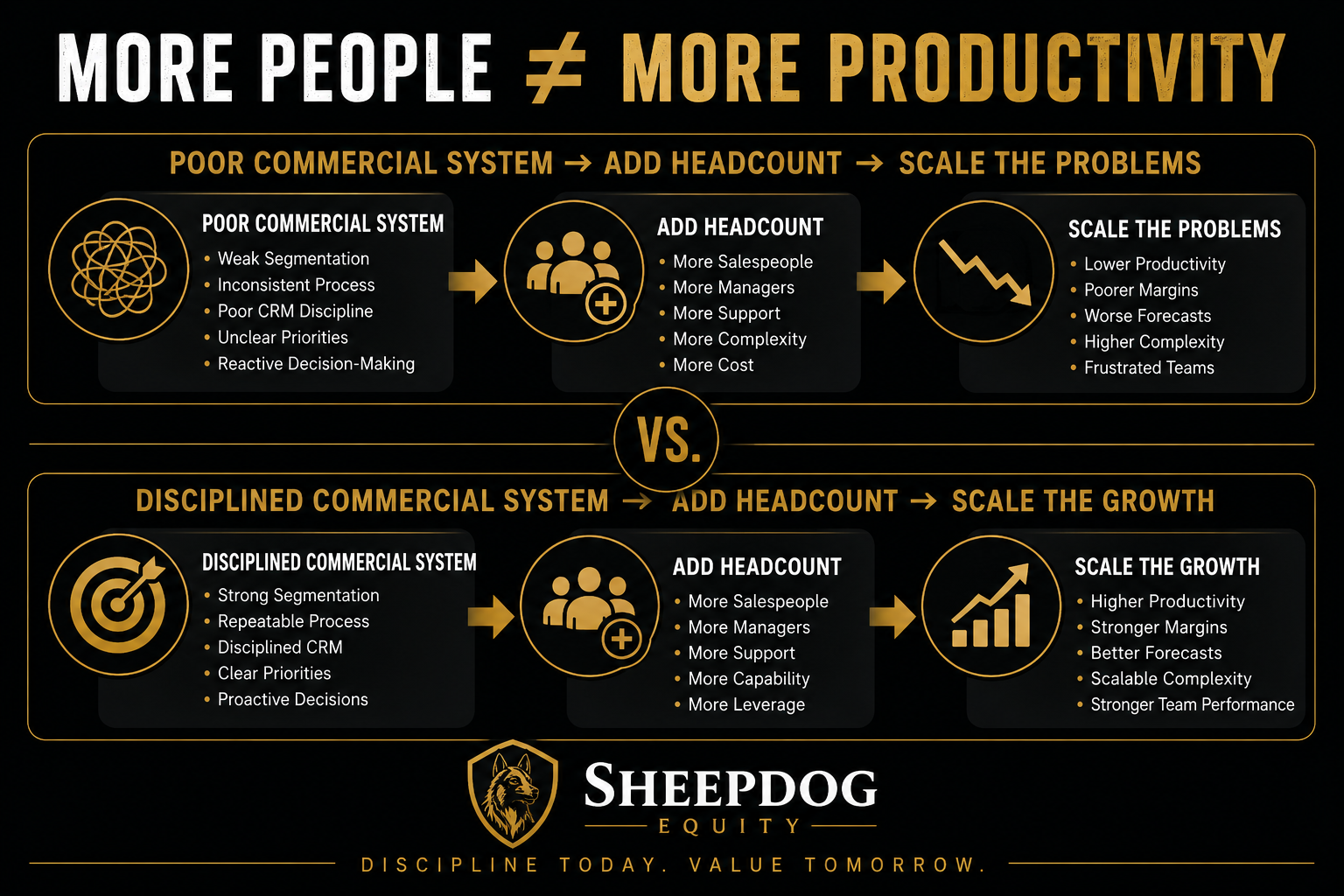
Growth Without Commercial Discipline Is Expensive
Why scalable value creation requires commercial discipline, not simply more salespeople, territories, and revenue.
Stephen D. Wallace
Sheepdog Equity
Growth is usually treated as evidence that a business is doing something right.
Sometimes it is.
Sometimes the company is simply getting bigger.
Those are not the same thing.
I have spent much of my career in industrial businesses where growth was expected, whether the company was privately held, family-owned, part of a multinational corporation, or backed by private equity. The pressure is understandable. Investors want returns. Owners want enterprise value. Employees want opportunity. Leaders want momentum.
But one of the most important lessons I have learned is that revenue can hide an enormous number of problems.
A company can grow while margins deteriorate. It can grow while sales productivity declines. It can grow while working capital gets worse. It can grow by adding customers it should never have pursued. It can grow while creating so much complexity that the organization eventually struggles under its own weight.
Growth is important.
Disciplined growth is far more valuable.
You Can Buy Revenue
There are plenty of ways to manufacture top-line growth.
Add salespeople.
Add territories.
Discount aggressively.
Accept unfavorable terms.
Customize everything.
Carry more inventory.
Take every piece of business that comes through the door.
Promise customers whatever is necessary to win the order and figure out how to deliver it later.
Most of those tactics can produce revenue.
The problem is that they can also produce organizational complexity, lower margins, higher working capital, frustrated operations teams, poor forecasting, and customers that consume more value than they create.
Revenue is relatively easy to measure. The organizational cost required to produce it is considerably harder.
That is why I become skeptical when growth is presented without explaining the commercial system behind it.
More Salespeople Is Not a Strategy
One of the easiest answers to a growth problem is to hire more salespeople.
Sometimes that is exactly the right answer.
But before adding headcount, I want to know whether the existing commercial system works.
Are territories designed correctly?
Are customers segmented?
Do we understand the ideal customer profile?
Is pricing disciplined?
Are salespeople spending their time on the right opportunities?
Does the CRM reflect reality?
Is the pipeline credible?
Are forecasts useful?
Can the organization distinguish activity from productivity?
If those fundamentals are weak, adding salespeople may simply scale the weakness.
Ten people operating inside a poorly designed commercial system do not necessarily become more effective when you hire five more.
You may just have fifteen people operating inside a poorly designed commercial system.
Headcount should scale a functioning commercial architecture, not substitute for one.