Revenue Isn’t Customer Value
A better way to think about customer segmentation, profitability, cost-to-serve, and growth potential.
Stephen D. Wallace
Sheepdog Equity
Most companies segment customers. Far fewer segment them in a way that actually helps them make better decisions.
The most common approach is also the easiest: rank customers by revenue. The largest customers become A accounts, the next group becomes B accounts, and everyone else falls somewhere below them.
It is simple. It is measurable. And it can be dangerously misleading.
Revenue tells you how much a customer buys. It does not tell you how valuable that customer is to the business.
I have seen large customers consume enormous amounts of organizational capacity while producing relatively little economic value. They demand special pricing, expedited orders, engineering changes, excessive customer service, unusual payment terms, constant management attention, and exceptions to normal operating processes.
On a revenue report, they look fantastic.
On an economic basis, they may be among the least attractive customers in the business.
At the same time, a smaller customer may purchase consistently, pay on time, require little support, generate attractive margins, fit the company’s capabilities, and have significant potential for future growth.
A revenue-only segmentation model can easily rank the first customer above the second.
That is the problem.
Customer Value Is Multidimensional
A useful segmentation model should reflect the economics and strategic value of the relationship, not simply historical sales.
At a minimum, I want to understand several dimensions of a customer:
Revenue
Profitability and margin
Cost-to-serve
Payment behavior and terms
Future growth potential
Strategic fit
Those variables begin to tell us something much more useful than revenue alone.
Consider cost-to-serve. Two customers generating identical revenue and gross margin can produce very different economic outcomes.
One places predictable orders, accepts standard products, pays according to agreed terms, and requires relatively little intervention.
The other generates constant expedites, engineering requests, small orders, special packaging, forecasting problems, pricing disputes, and management escalation.
The accounting system may show two similar customers.
The organization experiences two completely different customers.
That difference matters.
Segmentation Should Drive Decisions
Customer segmentation should not be an analytical exercise that produces a colorful chart for a quarterly meeting.
It should change behavior.
If a customer is truly an A account, sales should know what that means. Operations should know what that means. Customer service, product management, finance, and leadership should know what that means.
The classification should influence decisions about resources, service levels, pricing, inventory, product development, executive attention, and growth investment.
Likewise, lower-tier customers should not automatically receive the same organizational resources as customers creating substantially greater enterprise value.
This is where segmentation becomes useful.
It creates organizational choices.
Potential Matters Too
One weakness in purely historical segmentation is that it rewards what has already happened.
That can cause companies to underinvest in emerging customers.
A new customer may generate relatively little revenue today but have substantial potential based on market position, applications, geography, product fit, or share-of-wallet opportunity.
For that reason, I generally believe a new customer should initially receive the benefit of the doubt.
Treat a new customer like an A customer during the first year.
Give the relationship enough organizational support to determine what it can become.
Then let actual behavior and economics determine where the customer ultimately belongs.
Otherwise, companies can create a self-fulfilling problem: a potentially valuable customer receives limited attention because it is small, remains small because it receives limited attention, and is then classified as unimportant because it remained small.
The PITA Factor Is Real
There is another variable companies rarely put into formal segmentation models, although almost everyone in the organization knows it exists.
Some customers are simply extraordinarily difficult to serve.
Call it complexity. Call it organizational burden. Call it whatever makes everyone comfortable.
I have always thought of it as the PITA factor.
The terminology may not belong in the board presentation, but the economics absolutely belong in the analysis.
Every unnecessary expedite, exception, meeting, engineering change, invoice dispute, special request, and escalation consumes organizational capacity.
That capacity has a cost.
Ignoring it does not make the cost disappear.
A customer generating substantial revenue while consuming disproportionate resources may be less valuable than the income statement initially suggests.
Build the Model Around the Business
There is no universal weighting system for customer segmentation.
That is precisely the point.
The variables and their relative weights should reflect how the particular business actually creates value.
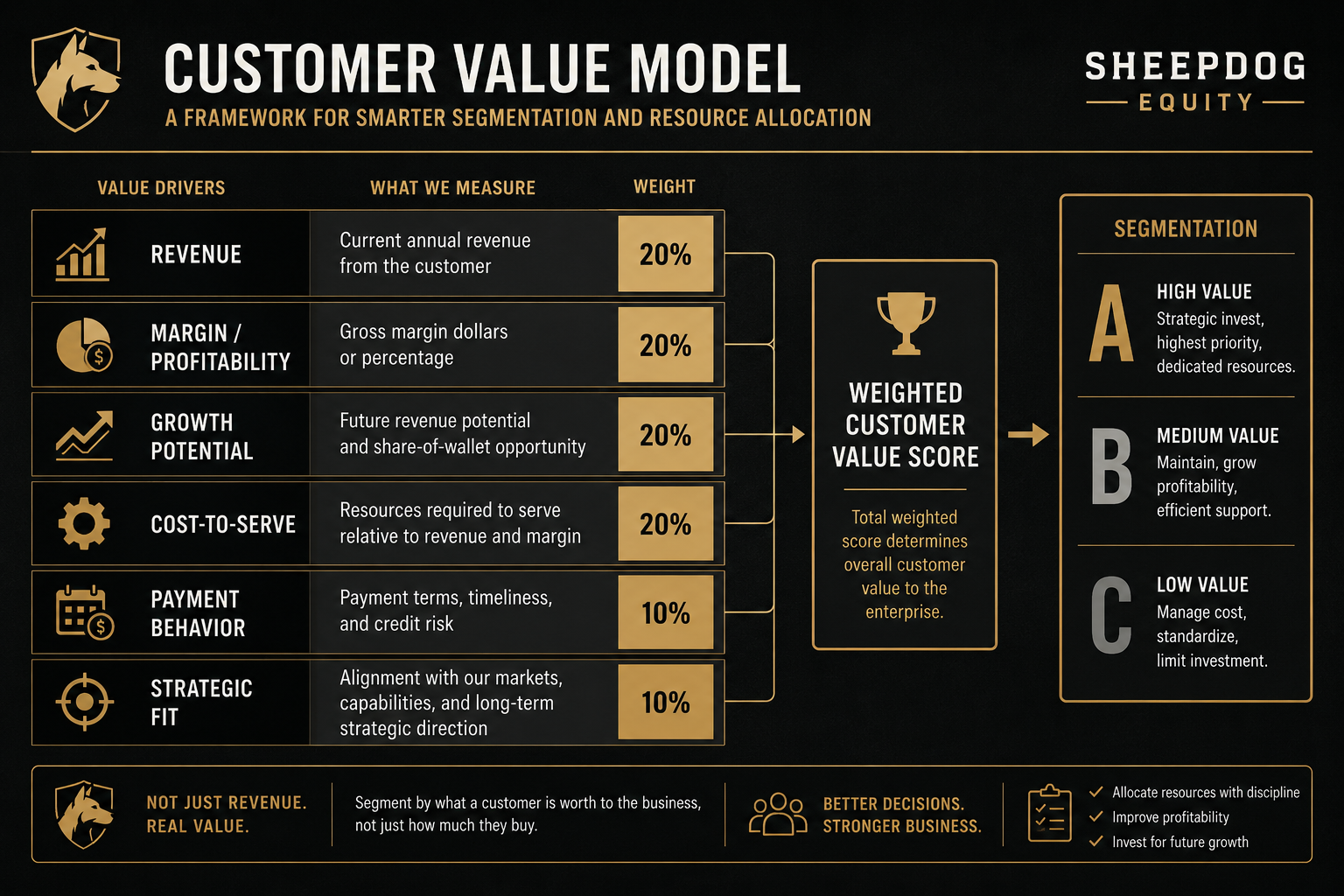
A company might build a weighted model around:
Current revenue
Margin contribution
Growth potential
Cost-to-serve
Payment behavior
Strategic fit
Each variable receives a score. Each score receives an appropriate weight. The combined result creates a more complete picture of customer value.
The exact mathematics matter less than the discipline behind them.
Management is forced to answer a much more important question:
What actually makes a customer valuable to this business?
That conversation alone can expose assumptions that have gone unchallenged for years.
Segmentation Is Really Resource Allocation
Ultimately, customer segmentation is not about labeling customers A, B, or C.
It is about deciding where the organization should invest scarce resources.
Sales time is finite.
Engineering capacity is finite.
Inventory is finite.
Management attention is finite.
Capital is finite.
Every resource committed to one customer is a resource that cannot simultaneously be committed somewhere else.
That makes segmentation a strategic allocation decision.
The objective is not simply to identify the customers producing the most revenue today. It is to identify the customers where the combination of economics, strategic fit, and future opportunity justifies greater organizational investment.
Revenue matters.
It just isn't the same thing as customer value.