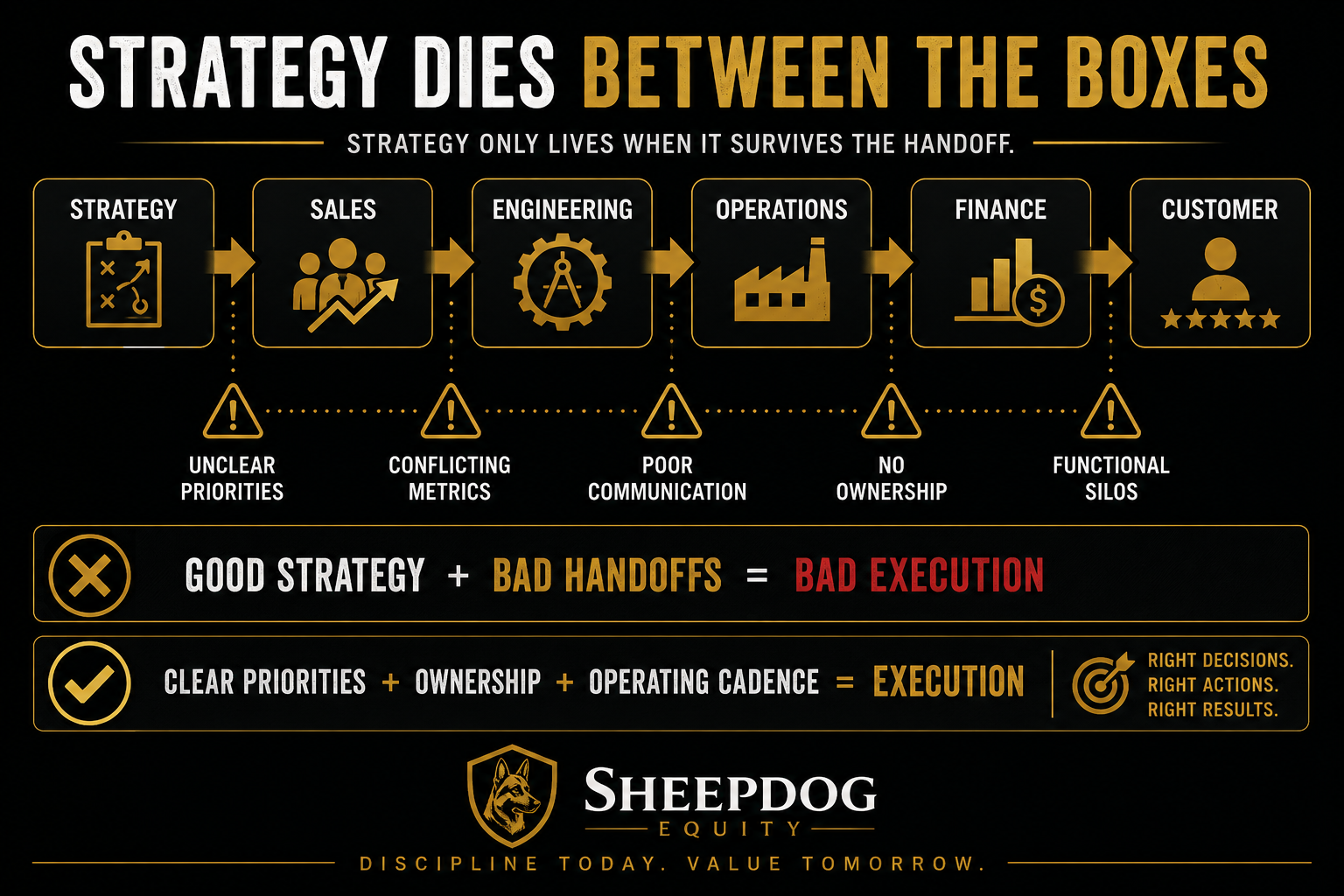
Strategy Dies in the Handoff
Why execution breaks down when priorities, accountability, and operating cadence fail to connect.
Stephen D. Wallace
Sheepdog Equity
Most companies do not suffer from a shortage of strategy.
They suffer from a shortage of execution.
The strategy gets developed. The priorities get discussed. The PowerPoint looks good. Everyone leaves the meeting agreeing on what needs to happen.
Then Monday morning arrives.
Sales goes back to selling. Operations goes back to producing. Finance goes back to reporting. Engineering goes back to engineering. Marketing goes back to marketing.
And somewhere between the strategy meeting and the daily work of the organization, the strategy begins to disappear.
That is the handoff.
And it is where a lot of otherwise good strategies die.
Strategy Has to Survive the Organization
A strategy is only useful if the organization can translate it into decisions and actions.
If the strategy says we are going to focus on higher-value customers, what changes Monday morning?
Which customers get more resources?
Which customers get fewer?
Which opportunities should sales pursue?
Which opportunities should they walk away from?
What does operations prioritize?
What does engineering stop doing?
What changes in pricing?
What changes in inventory?
What changes in capital allocation?
If the answers to those questions are unclear, the organization does not really have a strategy.
It has an aspiration.
The difficult part of strategy is not deciding what you would like the company to become.
The difficult part is translating that decision into thousands of smaller decisions made throughout the organization.
Everything Cannot Be a Priority
One of the quickest ways to destroy execution is to have too many priorities.
I have seen leadership teams identify ten, fifteen, or twenty “strategic priorities.”
Those are not priorities.
That is a list.
Strategy requires choices.
If everything matters, nothing matters enough.
Organizations have finite resources. They have finite capital, finite management attention, finite engineering capacity, finite manufacturing capacity, and finite commercial resources.
Every strategic decision therefore contains an allocation decision.
Where are we going to put our resources?
And just as importantly:
Where are we not going to put them?
That second question is usually harder.
Companies are generally much better at adding initiatives than stopping them.
Eventually the organization is carrying years of accumulated priorities, projects, meetings, metrics, products, customers, reports, and processes.
Then leadership wonders why execution is slow.
Accountability Has to Have a Name
Another common breakdown occurs when everyone is responsible.
When everyone owns something, there is a good chance nobody actually owns it.
Important initiatives need clear accountability.
Not a committee.
Not a department.
A person.
That does not mean one person performs all the work. Most meaningful initiatives cross functional boundaries.
But somebody needs to know that the result ultimately has their name attached to it.
Who owns the outcome?
What exactly are they expected to deliver?
By when?
How will we know whether it worked?
What happens when it gets off track?
Those questions sound elementary.
They are also remarkably easy for organizations to avoid.
The Handoffs Are Where Complexity Lives
Most businesses are organized vertically.
Customers are not.
A customer opportunity may move through marketing, sales, estimating, engineering, operations, supply chain, finance, logistics, and service.
Each function can perform its individual task reasonably well while the overall customer experience remains terrible.
Why?
Because the failure occurs between the functions.
Sales makes a commitment operations never agreed to.
Engineering designs something manufacturing struggles to produce.
Operations optimizes production while inventory grows.
Finance tightens working capital while sales is promising customers additional inventory.
Marketing generates leads sales does not value.
None of those problems necessarily originate inside a single department.
They originate in the handoff.
That is why optimizing individual functions does not necessarily optimize the business.
The organization has to manage the connections between them.
Metrics Can Create the Same Problem
Metrics are supposed to create clarity.
Poorly designed metrics create conflict.
Sales is measured on revenue.
Operations is measured on efficiency.
Finance is measured on working capital.
Customer service is measured on responsiveness.
Procurement is measured on purchase price.
Each function can hit its number while making another function's job more difficult.
Worse, the company can hit several functional metrics while destroying enterprise value.
The question should not simply be:
Did the department hit its target?
The better question is:
Did the business get better?
Metrics should reinforce the strategy and each other.
Otherwise, the organization can become extremely efficient at working against itself.
Operating Cadence Matters
Strategy cannot be something leadership discusses once a year.
Execution requires cadence.
There needs to be a rhythm where the organization repeatedly asks:
What did we say we were going to do?
What actually happened?
Where are we off plan?
Why?
What decision needs to be made?
Who owns the next action?
When will we review it again?
This does not require endless meetings.
In fact, excessive meetings are often evidence that the operating system is not working.
A good operating cadence should reduce noise.
The right people should be looking at the right information at the right frequency and making decisions while those decisions still matter.
Weekly issues should not wait for quarterly reviews.
Strategic issues should not consume daily operating meetings.
Different decisions require different cadences.
Execution Requires Saying No
This may be the hardest part.
Execution is not primarily about doing more.
It is often about deciding what the organization will stop doing.
Stop pursuing customers that do not fit.
Stop carrying products that create complexity without adequate return.
Stop launching initiatives without resources.
Stop customizing everything.
Stop accepting work that consumes more value than it creates.
Stop measuring activity simply because it is easy to measure.
Stop allowing priorities to remain priorities forever.
Every organization has limited capacity.
Strategy determines where that capacity should go.
Execution protects it.
The Test Is What Happens Monday Morning
I have always believed strategy should eventually become visible in the daily behavior of the organization.
You should be able to walk through the business and see it.
You should see it in the customers salespeople pursue.
You should see it in pricing decisions.
You should see it in the production schedule.
You should see it in engineering priorities.
You should see it in inventory.
You should see it in hiring.
You should see it in capital allocation.
You should see it in what managers discuss with their teams.
And perhaps most importantly, you should see it in what the company chooses not to do.
If the strategy changes but none of those things change, the strategy probably did not make it very far.
It died in the handoff.